
Hickory City Directory Collections and Shelves
Hickory city directories are a selected run, not an unbroken annual roll. The located volumes begin with 1920-21 and reach 1949-50, under the names C. L. Whitener, Ernest H. Miller, Home Directory Company, and Charles W. Miller or Southern Directory Company. DigitalNC has item records for the run, while Patrick Beaver Memorial Library supplies a local place to consult related genealogy material and microfilm. The absence of a volume in the located list does not establish that none was printed. Keep the volume year, publisher, call number, and scan or shelf source with every transcription.
| Hickory collection | Located years | Where held | Access route |
|---|---|---|---|
| Whitener, Miller, Home Directory, and Southern Directory volumes | 1920-21 through 1949-50, selected years | DigitalNC metadata, UNC Wilson and Duke records | Free item pages and scans where linked |
| Hickory Daily Record obituary index | 1915-1989 | Patrick Beaver Genealogy/North Carolina Room | Index lead, then consult room instructions for the clipping or newspaper |
| Shuford Funeral Home records | 1908-1957 | Patrick Beaver local-history resources | Historical lead, not a promise of online access |
| Local newspapers and court microfilm | Piedmont Press 1873-1886; selected county series | Patrick Beaver Memorial Library | In-room research and title-list confirmation |
A continuous address-arranged, or criss-cross, run was not confirmed in the official materials reviewed. Ask Patrick Beaver or the Rhodes Room whether a telephone-book or address-arranged volume exists for the specific years needed. That careful question is better than promising an address search the digitized titles do not show.
Hickory City Directory Volumes Online
DigitalNC's North Carolina City Directories collection is the practical online shelf for the located Hickory volumes. Its records identify the 1920-21, 1925-26, 1928-29, 1930-31, 1935, 1937-38, 1941-42, 1943-44, 1947-48, and 1949-50 editions. The item record matters as much as a page image: it retains the volume date, publisher, holding institution, and, for several scans, an Internet Archive identifier. Those details make a later check possible when two entries look similar or a page is clipped from its title page.
The 1935 Hickory directory record on DigitalNC illustrates the online item route before a person begins transcribing an entry.
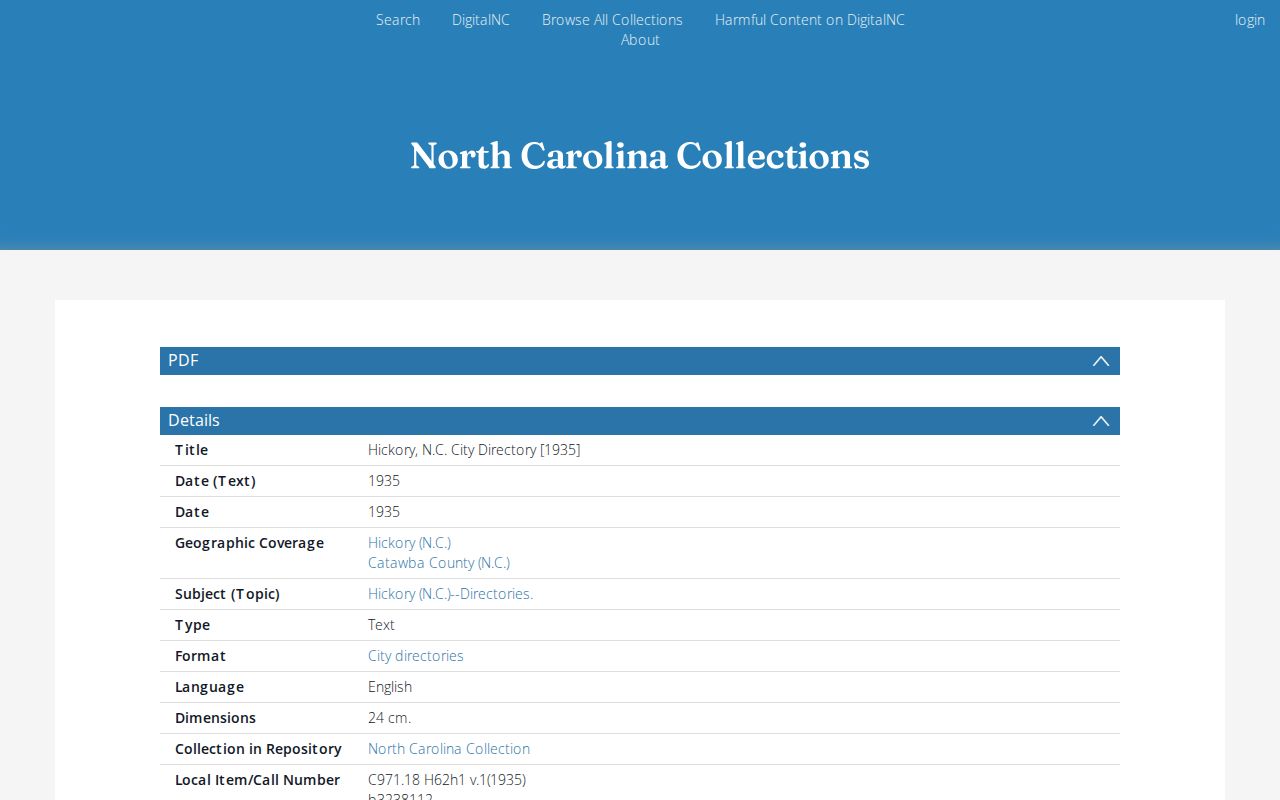
The image is a reference point for a digitized volume, not evidence that every year or every page is online. When a name falls between editions, use the closest dated directory alongside newspaper microfilm, an obituary index, or a census schedule rather than filling the interval with assumption.
Note: DigitalNC volumes are dated sources, so record the edition year before comparing any address or household detail.
Hickory City Directory Research at Patrick Beaver
The Genealogy/North Carolina Room at Patrick Beaver Memorial Library, 375 3rd Street NE, brings the supporting shelf close to Hickory directory work. Its holdings include printed family genealogies, local and church histories, yearbooks, maps, clippings, scrapbooks, community-organization minutes, microfilm, and licensed research tools. The room also identifies the Hickory Daily Record obituary index for 1915-1989 and Shuford Funeral Home records for 1908-1957. These materials can test a household change without turning a directory line into a claim about a current person.
The library lists hours of Monday through Thursday 9 to 8, Friday and Saturday 9 to 5, and Sunday 1 to 5. Fragile material is used in the room, so confirm special equipment or collection access before a visit. Local library context also helps with a directory feature that a scan cannot explain, such as a changing abbreviation or a missing part of a run.
The library's genealogy-room page describes the local history setting behind this Hickory city directory work.

Its obituary index, funeral records, yearbooks, and microfilm are useful companions when an entry appears, changes, or disappears between directory years.
Reading a Hickory City Directory Entry
A Hickory city directory entry should be read as a compact statement made for one edition. The 1935 sample page places names in alphabetical order and can print a spouse in parentheses, a work or business reference, an address, and separate civic or business blocks. Its city-official material identifies offices such as the fire department and municipal leadership, which makes the book a source for institutional history as well as family research. It does not supply a modern parcel number or ZIP code. Preserve punctuation and unexplained numerals instead of translating them into modern database fields.
| Name sequence | Alphabetical name as printed, including middle initials and spelling variants. |
|---|---|
| Family notation | A spouse may appear in parentheses; widow notation can supply a relationship lead that needs confirmation. |
| Work or business text | Occupation, employer, or a business reference may appear as historical context, not present-day verification. |
| Home line | A house number and street often follow the printed home marker, direction, or city shorthand. |
| Civic blocks | Separate listings can identify departments, churches, schools, and businesses of the volume's year. |
- Criss-cross directory
- An address-arranged directory that can place entries by street rather than by surname. No dedicated Hickory run was confirmed, so ask the local rooms about particular years.
- Householder index
- An index organized around a household or address. It is useful only when the volume explicitly provides that arrangement.
- Abbreviation key
- The volume's own list of shortened terms and markers. Read or photograph it first, because the same letter can have a different convention in another edition.
Where the printed key is absent or uncertain, retain the shorthand without expanding it. A later catalog, map, or local-history source may supply context, but it should not overwrite what the volume actually says.
Hickory City Directories and Changing Addresses
Printed addresses need a date before they can be mapped. Hickory's grid was platted in the 1865-70 period, the city adopted a street-numbering plan in 1908, and Highland and West Hickory merged into Hickory in 1931. An entry that seems wrong on a current map may instead reflect the street numbering, direction abbreviation, neighborhood name, or municipal geography of its own year. Keep the line in its printed form before trying to match it to a current parcel.
For a map bridge, compare the date of the entry with the Catawba GIS historic tax-map index, street-name PDFs, and the Hickory Sanborn dates located for 1907, 1913, 1919, 1925, and 1931. The Library of Congress Hickory Sanborn item is another dated map lead. Historic building footprints and current parcel lines are not one-to-one, so they should not be treated as a legal boundary or proof of current occupancy.
Note: A dated street form is often the key evidence, especially around the 1908 numbering change and the 1931 merger.
Hickory City Directory Years in Context
Directory volumes sit inside a longer local record timeline. Catawba County was formed in 1842, with Newton selected as county seat in 1845, so deeds and court materials may predate the civic name printed in a later Hickory directory. Hickory's own sequence includes a railroad arrival in 1859, its first charter in 1863, the Hickory Tavern name in 1870, the shortened Hickory name in 1873, and city status in 1889. These milestones explain why a place, government block, or street reference can change across the shelf.
- 1842-1845: Catawba County forms and Newton becomes the county seat, establishing the county custodian path for older deeds and court records.
- 1865-70: The Hickory grid is platted, creating an early street framework for later map and directory comparison.
- 1908: Hickory adopts its street-numbering plan, a key warning against modernizing historic entries too quickly.
- 1920-21: The first officially located Hickory directory scan begins the available selected run.
- 1931: Highland and West Hickory merge into Hickory, changing the municipal context of some historical references.
- 1949-50: The last located volume in this selected online inventory appears; it is not proof that printing ended then.
Each date changes the likely custodian and address form. A careful timeline keeps city history, county records, and the directory shelf from being treated as one undated source.
Trace Hickory Households Through City Directories
Family history works best when every source is allowed to answer its own question. A directory can put a surname at a dated street address; census microfilm can add a household structure for the released period; an obituary, funeral record, deed, estate, or vital record may test the relationship. Patrick Beaver has North Carolina federal census microfilm from 1790 through 1930 and Soundex material for 1880 through 1930. Newer federal census schedules follow the 72-year release rule. Keep the physical and online source location with each directory transcription.
- Choose the directory edition closest to the known event and transcribe the entire entry exactly.
- Check an adjacent available edition for the same surname, spouse notation, street form, and civic shorthand.
- Pair the dated line with a nearby released census schedule, keeping the directory address and census household as separate evidence.
- Search the obituary index or funeral records by date range and spelling variant when the household changes or disappears.
- Use a deed, estate, vital, or court source only to confirm the precise relationship or property event it actually records.
A disappearance can reflect a move, death, changed spelling, a gap in the located run, or a different editorial choice. It is not proof by itself. A same-name match also remains a lead until date, place, and a unique record detail agree.
Hickory City Directory Leads Beyond the City
Hickory is in Catawba County, but Newton is the county seat. That division sends estate, deed, and county-history questions to county resources even when the directory prints a Hickory street. The Evelyn D. Rhodes Room at 115 W C Street in Newton focuses on Catawba families, surrounding counties, and pre-North Carolina migration. Its listed hours are Tuesday through Saturday, 9 a.m. to 6 p.m. The room's local focus makes it a useful next stop when a surname crosses municipal labels.
The Historical Association of Catawba County adds family files, bound Hickory Daily Record and Hickory News runs, yearbooks, photographs, and National Register files. Research assistance is limited and self-use is scheduled, so confirm access and reproduction terms before relying on a trip. For older county categories, the State Archives guide and copy-request route can supply a further custodian path.
Limits of a Hickory City Directory Match
A city directory is a dated index, not a complete resident roll. It can omit people, use editorial shorthand, and reflect the broader commercial geography called greater Hickory rather than a present city boundary. The 1943-44 preface, for example, gives separate city and greater-Hickory figures, so neither should be converted into a current city count. Directory occupation, address, and family notation are historical leads that need date-aware corroboration.
Use official custodians for the record at issue and keep copied personal details to the minimum needed for genealogy, family history, civic research, or a house-history question. North Carolina privacy protections can limit what a public index displays. Never use a historical record trail to stalk, harass, or harm a living person.
Note: The best directory result preserves its volume, page, year, and source alongside the transcription.